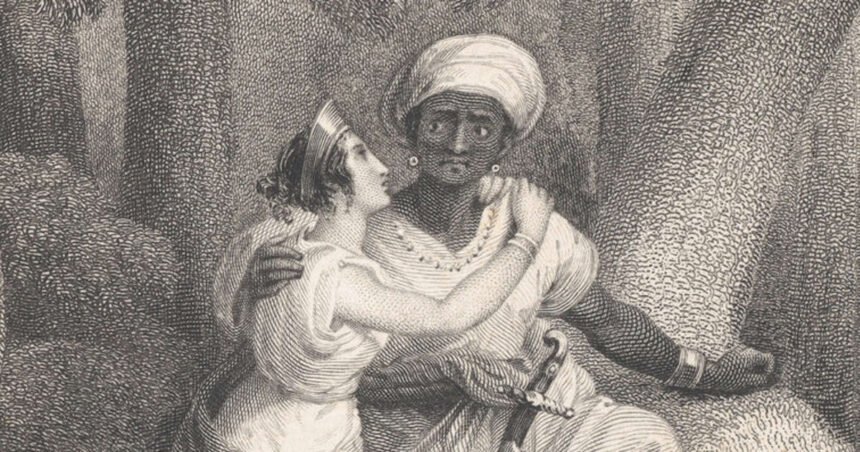
William Shakespeare’s famous tragedy Othello is often the first work that comes to mind when asked about the references of the popular British writer to race. And if it’s not Othello, people often mention The Merchant of Venice, Antony and Cleopatra, The Tempest, or his first – and bloodiest – tragedy, Titus Andronicus, my favorite work by Shakespeare.
Among experts, these five works are known as his «racial works», and include black characters – like Othello -, Jews – like Shylock -, indigenous – like Caliban – or black Africans – like Cleopatra -.
Reconstructing the face of a Neanderthal woman who lived 75,000 years ago
Read article
However, the truth is that all his works address race in some way. After all, every human being has a racial identity, and the characters Shakespeare brought to life also did, from Hamlet to Hippolyta.
It must be acknowledged that the playwright wrote about many key issues in the late 15th and early 16th centuries that are highly relevant today, such as gender, addiction, sexuality, mental health, social psychology, sexual violence, antisemitism, sexism, and of course, race, which we will discuss in this article.
Nobody should fear Shakespeare
For a long time, I was afraid of Shakespeare. And I’m not alone.
In his 1964 essay Why I Stopped Hating Shakespeare, James Baldwin detailed his initial resistance. Like many people today, Baldwin wrote that he too was «a victim of that loveless education that makes so many students detest Shakespeare.»
Much of Baldwin’s aversion to Shakespeare had nothing to do with the English writer, but rather with the white elitism surrounding his work and literature.
But as Baldwin came to understand, Shakespeare was not the «author of his oppression.» Just as Shakespeare did not create misogyny and sexism, he did not create race and racism. Instead, he observed the complex realities of the world around him, and through his works articulated a underlying hope for a fairer world.
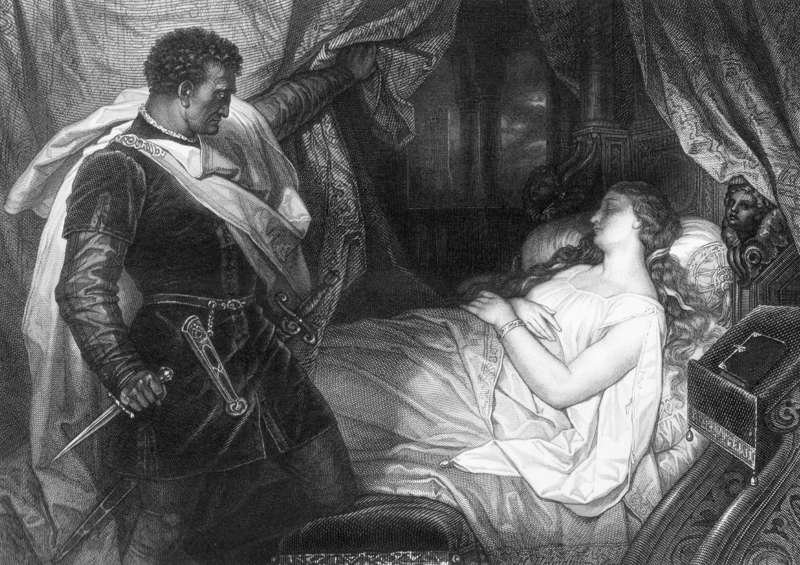
Othello Shakespeare
Othello and Desdemona, illustrated by Eduard Büchel (1835-1903).
Wikimedia Commons
Shakespeare’s work reveals social injustice
In Titus Andronicus, the playwright’s first black character, named Aaron, appears. In this play, written in the late 16th century, the white Roman empress Tamora deceives her husband, the white emperor Saturninus, with Aaron. When Tamora gives birth, it becomes clear that the baby’s father is not Saturninus.
As a result, the white characters who know the baby’s true father urge Aaron to kill his newborn black son. But Aaron refuses. Instead, he fiercely protects his beloved child.
Amidst all the drama surrounding the child’s existence, Shakespeare momentarily offers a beautiful defense of blackness in the fourth act of the play.
“Is black such a low tone?”, Aaron asks before challenging cultural norms. “Black coal is better than another shade, in that it scorns to carry another hue.” In other words, at least for Aaron, being black was beautiful, blackness exuded strength.
Such words about black identity are not spoken in any other work of Shakespeare, not even in Othello.
The power of white skin
In works like Hamlet, Macbeth, and Romeo and Juliet, race remains part of the drama even when there are no dominant black characters. Among other things because Shakespeare highlights the racial whiteness of his characters.
In Shakespeare’s time, as it is today, the supposed superiority of having fair skin meant that social status was negotiated by everyone based on the norms of the dominant culture.
In several of his works, for example, the playwright speaks of “white hands” as a symbol of purity and superiority. He also draws attention to the race of his characters by describing them as “white” or “blond.”
Shakespeare also used black as a metaphor for being tainted, for instance in the comedy Much Ado About Nothing. A white young woman, Hero, is falsely accused of deceit by her fiance, Claudio, on her wedding day. Claudio and Hero’s father, Leonato, shame Hero for her alleged lack of chastity, something forbidden for English women in the 16th century, who were legally their father’s property and subsequently their husband’s.
Unmarried women having sex before marriage violated the expectations of a male-dominated culture. With Hero’s supposed sexual purity tarnished, her father describes her as “plunged in a well of ink.”
Thus, in this play, Hero momentarily represents a “inked” white woman, which is a symbolic reflection of the stereotyped and hypersexualized black woman.
Studies and essays on Shakespeare and race
In recent years, researchers have brought new perspectives on the social, cultural, and political issues of Shakespeare’s time, comparing them to our own. Moreover, there are dozens of scholars and theater professionals who dedicate their professional lives to exploring race in Shakespeare’s literature and era.
For example, in 2020 playwright Anchuli Felicia King wrote Keene, a satire of Othello that offers a contemporary critique of whiteness. In the play, a Japanese musicologist named Kai and Tyler, a black Ph.D. student, meet at a Shakespeare conference, where they are the only two people of color in the elitist gathering of whites. While Tyler focuses on writing his thesis, Kai focuses on Tyler. A romance ensues, only to see Tyler – like Othello before him – betrayed by his white closeted confidant, Ian.
In 2019, British actress Adjoa Andoh directed Shakespeare’s play Richard II with an all-female cast of color, a production she described as “a thought experiment about the universality of humanity.”
David Sterling Brown, Associate Professor of English, Trinity College
This article was originally published in The Conversation. Read the original.